Saturday, March 31, 2007

Mosquito Soldier

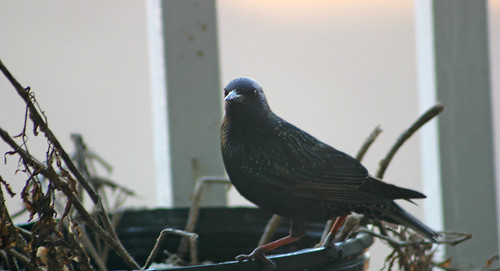
The first thing that came to my mind when I saw this gigantic mosquitoish thing was the recent article about genetically altered mosquitoes in the fight against malaria.

For millions of people suffering from the scourge of malaria, anything to fight this disease is probably welcome news. I am always uncomfortable when people tinker with the nature, but malaria resistant mosquitoes are probably a million times better than the use of DDT!

One can only hope that these mosquitoes are only released after extensive and conclusive studies and tests. We have all heard of bizarre failures before. Used tires to build fish habitat ended up choking it instead. Toxic toad introduced in Australia to fight sugar pests ended up destroying native species. There are many more of these sad experiments. I can go on and on.

Neem has long been an essential ingredient in Ayurvedic medicine. It is called Sarva Roga Nivarini (curer of all ailments). Studies have shown that Neem has several anti malarial properties. Could Neem offer a better way out?

My point is this. Learn from nature not experiment with it. As folks at Biomimicry put it, let nature be the mentor.

Quote of the day
"When one tugs at a single thing in nature, he finds it attached to the rest of the world."~John Muir [quotegarden.com]

Monday, March 26, 2007

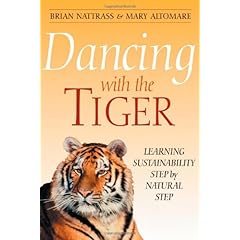
Dancing with the Tiger

I was MIA (Missing Internet Access) the last couple of days and I am happy to say that I survived! Once you get used to fast and cheap internet access, you can almost be assured of IWS (Internet Withdrawal Symptoms). The most obvious symptom is that you catch up on your book reading.

Dancing with the Tiger is required reading for the class that I am taking currently. I am glad it is.

Like I mentioned before, the term sustainability is defined in several ways and used in several different contexts. I have always wondered what a good definition and a good measure of sustainability would be. And after you understand it, how would one go about implementing it. This book answers just that.
The Natural Step provides a simple, yet elegant, framework to integrate environmental issues into the frame of business of reality and to move the company toward sustainable development. The framework provides a whole-systems perspective, first articulated by Dr. Karl Henrik Robèrt and Dr. john Holmberg, that explains systems in the simplest way so an organization can deal with complexity without either getting lost in it or denying that it exists.

[...]

The mechanisms through which human activities can deteriorate, or otherwise negatively effect, nature are then translated into statements concerning the minimum environmental criteria a society must meet to be sustainable. These statements are then articulated as the four System Conditions.

In the sustainable society, nature is not subject to systematically increasing...
1. ...concentrations of substances extracted from the Earth's crust,
2. ...concentrations of substances produced by society, or
3. ...degradation by physical means;
and in that society
4. ...human needs are met worldwide.

As simple as that. The book tells the story of companies like Nike and Starbucks who have adopted the Natural Step. It looks at their successes, and their struggles on the road to sustainability. While the Natural Step framework provides a simple understandable premise, achieving true sustainability is in no measure easy.
As advisors on sustainable business practices and corporate responsibility working directly with the sustainability innovators and pathfinders within these organizations, we were able to share their triumphs and frustrations, come to understand their motivations, observe their behavior, and witness the challenges of their roles as internal change agents for sustainable development and greater corporate responsibility. It was through this experience that the metaphor "dancing with the tiger" arose. How does one dance with the tiger? You do it carefully, skillfully, courageously, and in tune to the same music, and advancing step by natural step
I am really digging this book! I hope to learn a dance step or two.

Saturday, March 17, 2007

Tuesday, March 13, 2007

Solar Auto Rickshaw

Sheel finds this interesting solar auto rickshaw during his trip to Bangalore.
I couldn’t find the driver so I don’t know full details - but there are solar cells all over the thing. I’d find it hard to believe that it runs entirely on solar power… my guess is that you plug it into the wall at night and the solar power just helps to recharge. Very cool nonetheless… I wonder if it makes fiscal sense to unleash these all over the country… It’d be an awesome thing from a pollution standpoint, as I think rickshaws are a pretty big contributor to pollution in cities in India.
[via Sheel Mohnot]

I have never heard of a solar rickshaw before. A bit of googling revealed this and this.

Anyone heard/seen one of these before ?

Sunday, March 11, 2007

Green Advertisements: A Treasure Chest


UNEP's creative gallery on sustainability communications is a treasure chest of green ads. A must visit. How did I ever miss this before?

I wish the gallery had a feed of some sort. More importantly, I wish they opened up a channel on YouTube. Would attract a wider audience.

On the subject of sustainability communications, we all associate the term recycle with one particular image. Not sure if that is the case with the term sustainability.

Saturday, March 10, 2007

Micro-Finance & Solar Lighting

This idea has been jumping in my head for some time now. I wanted to make sure my idea was viable before I posted it. But I can't hold it back anymore. Here goes....

Many of you might have already heard of the delightfully cool Kiva.org. An idea that is so simple and yet so powerful. It brings together the power of Internet and micro-finance to change lives all over the world. I am proud to say that I am a loaner!

Kiva is currently finalizing its micro-finance field partnerships in India. I believe they are looking at SKS India and GrameenKoota. As soon as the Reserve Bank of India clearance comes through, we will start seeing entrepreneurs from India listed on the site. It could be as early as end of March/ beginning of April 2007.

I have mentioned SuryaBijlee before. Alumni from Indian Institute of Technology are behind it. They are a Non-Profit trust and their mission is to bring affordable solar lighting to rural homes. They use the latest Amorphous Silicion technologies for their arrays and ultra efficient LED for lighting. SuryaBijlee depends entirely on donations for new installations. A little from their website...
For the millions of villagers, life comes to a grinding halt at sunset — with no electricity, there is no light, so no ability to work or study or play. Having spent the major part of the day in the fields, the villagers can do little in the darkness. There is no light for children to study or for any family entertainment.
India has over 140 Million Rural Homes. Out of this some 87 Million still burn kerosene for lighting. Each family consumes between 100-150 liters of kerosene per annum.Each liter of kerosene generates 2.6 kgs of Carbon Dioxide. Annually, this is over 22 million tons of pollution
So here is my idea... bring together Kiva, SuryaBijlee and carbon offset providers like TerraPass together. A single home lighting system costs about 60$. Kiva lenders fund the project. SuryaBijlee executes the project and does the necessary installations. The villagers repay it over a period of time. If we can get TerraPass to fund a part of the project, the repayment amount can be cut by that much. Would make it even more affordable and attractive.

Jasjeet Singh from SuryaBijlee is on board. I am yet to hear back from Sheel Mohnot, Kiva's SouthAsian Partnership Manager. I will pitch this idea to folks at TerraPass also.

What say you? Make any sense ?

PS: South Africa is already doing something similar. As per their calculations, families can afford to repay the loans over 1 year from money saved not having to buy candles and paraffin.

Friday, March 09, 2007

Sustainability

The obvious first question that came up in class, What is Sustainability?

I have to admit, I have used the term several times before, but never with a set definition in mind. The oldest definition is probably the one from the Brundtland Commission
Sustainable development is development that meets the needs of the present without compromising the ability of future generations to meet their own needs
I however prefer the US EPA definition
Sustainability is the ability to achieve continuing economic prosperity while protecting the natural systems of the planet and providing a high quality of life for its people
Now for the second obvious question, How do you measure Sustainability? That, is a question I have no good answer to. Not yet.

Saturday, March 03, 2007

Al Gore Psuedo Scandal: A Rebuttal

By now, Gore bashing sound bites must have travelled far and wide, thanks to cable. If you are wondering if it is all true, David Roberts of GristMill has a brilliant rebuttal. A must must read
The Tennessee Tax Dept. does not consider the "Tennessee Center for Policy Research," which roughly no one had heard of before this, a legitimate group. It's run by a long-time right-wing attack hack, and its only registered address is a P.O. box. Why is everyone in the media taking what it says about Gore's electricity use at face value?

Gore's electricity company has no record of being contacted about his bills.

The "average" home electricity use quoted by TCPR is a national average that includes apartments and mobile homes. In Gore's climatic zone, the East South Central (Dept. of Energy PDF), the average is much higher, thanks to hot, humid summers and cold winters. Within that zone, Gore's usage is three (not 20) times average, and his per-square-foot usage is squarely average.

The Gores are not an average family. He's an ex-VP with special security arrangements, and has live-in security staff. He and his wife both work on their many business and charitable undertakings out of their house, so they have space for offices and office staff. All that would be tough to cram in an average size house.

Gore buys the maximum allowable green electricity from the program offered by his utility.
Most of the electricity in TN comes from hydro and nuclear, and so doesn't generate all that much CO2 anyway

I use a similar program to buy green power from my utility. The power is sourced from local wind farms.

On his part, Al Gore could have done a little solar roofing. But the fact remains, Al Gore has done a tremendous job in increasing global warming awareness. Right wing nut cases know that painfully well. Al Gore is making great progress and people are listening. Like Patrix puts it, swift boating is not going to work this time around.

PS:
I am pretty sure the right wing nuts will have nothing to say about the deliberately delayed US Climate Action Report (which probably should be called a US Climate No-Action report)