Showing posts with label Solar Energy. Show all posts

Tuesday, March 13, 2007

Solar Auto Rickshaw

Sheel finds this interesting solar auto rickshaw during his trip to Bangalore.
I couldn’t find the driver so I don’t know full details - but there are solar cells all over the thing. I’d find it hard to believe that it runs entirely on solar power… my guess is that you plug it into the wall at night and the solar power just helps to recharge. Very cool nonetheless… I wonder if it makes fiscal sense to unleash these all over the country… It’d be an awesome thing from a pollution standpoint, as I think rickshaws are a pretty big contributor to pollution in cities in India.
[via Sheel Mohnot]

I have never heard of a solar rickshaw before. A bit of googling revealed this and this.

Anyone heard/seen one of these before ?

Saturday, March 10, 2007

Micro-Finance & Solar Lighting

This idea has been jumping in my head for some time now. I wanted to make sure my idea was viable before I posted it. But I can't hold it back anymore. Here goes....

Many of you might have already heard of the delightfully cool Kiva.org. An idea that is so simple and yet so powerful. It brings together the power of Internet and micro-finance to change lives all over the world. I am proud to say that I am a loaner!

Kiva is currently finalizing its micro-finance field partnerships in India. I believe they are looking at SKS India and GrameenKoota. As soon as the Reserve Bank of India clearance comes through, we will start seeing entrepreneurs from India listed on the site. It could be as early as end of March/ beginning of April 2007.

I have mentioned SuryaBijlee before. Alumni from Indian Institute of Technology are behind it. They are a Non-Profit trust and their mission is to bring affordable solar lighting to rural homes. They use the latest Amorphous Silicion technologies for their arrays and ultra efficient LED for lighting. SuryaBijlee depends entirely on donations for new installations. A little from their website...
For the millions of villagers, life comes to a grinding halt at sunset — with no electricity, there is no light, so no ability to work or study or play. Having spent the major part of the day in the fields, the villagers can do little in the darkness. There is no light for children to study or for any family entertainment.
India has over 140 Million Rural Homes. Out of this some 87 Million still burn kerosene for lighting. Each family consumes between 100-150 liters of kerosene per annum.Each liter of kerosene generates 2.6 kgs of Carbon Dioxide. Annually, this is over 22 million tons of pollution
So here is my idea... bring together Kiva, SuryaBijlee and carbon offset providers like TerraPass together. A single home lighting system costs about 60$. Kiva lenders fund the project. SuryaBijlee executes the project and does the necessary installations. The villagers repay it over a period of time. If we can get TerraPass to fund a part of the project, the repayment amount can be cut by that much. Would make it even more affordable and attractive.

Jasjeet Singh from SuryaBijlee is on board. I am yet to hear back from Sheel Mohnot, Kiva's SouthAsian Partnership Manager. I will pitch this idea to folks at TerraPass also.

What say you? Make any sense ?

PS: South Africa is already doing something similar. As per their calculations, families can afford to repay the loans over 1 year from money saved not having to buy candles and paraffin.

Sunday, February 11, 2007

Hariyali Express. Solar Technology Innovators


The World Economic Forum meeting in Davos last month was teeming with business and political leaders. Lost in all the glitz were the technology innovators. So it is Hariyali Express to the rescue!

Several companies were recognized as innovators. Five among them , for leading the way on solar energy technology. Let us take a look shall we?

1) ClimateWell. When you think of solar energy, salt is probably the last thing that comes to mind. ClimateWell's solar powered indoor climate system is all about hygroscopic salts and of course the Sun.
A chemical heat pump is based on the principles that water molecules bind more efficiently to certain hygroscopic salts than to other water molecules. As a consequence, when using two separate bowls – one containing water (evaporator), and the other containing hygroscopic salt (reactor) - in a confined space, water will evaporate to the salt that absorbs the water. When the confined space is in a state of vacuum the water transport will be so high that the water will start boiling in order to produce vapour at the same speed as it is absorbed by the salt. Such evaporation requires energy. If the energy is not supplied from outside the system it will be taken from the water itself, which as a consequence gets colder

ClimateWell uses this principle to cool. To heat, solar energy is provided to the absorption process. Simply Brilliant isn't it ? Check out the interview with CEO Per Olofsson here. The modular design makes this suitable for hotels and offices. Which is why I am surprised that ClimateWell's current business model is aimed at large scale installations and not individual homes. This would be a boon (if economically viable) for the Indian summer.


2) Flisom. I always wish electronic gadgets would come with device integrated solar cells. From the looks of it, it will become a reality. Flisom is involved in doing just that. They have developed a copper-indium-gallium-selenide brew that gets great light-to-electricity conversion efficiency. Even better, it can be etched on to extremely thin plastic, thinner than a sheet of paper! Cell phone surface could be a potential application. The high conversion efficiency means lesser material and hence lesser cost. CEO and founder Anil Sethi expects this to become a mass technology. Mr Jobs, you listening ?

3) Nanosolar. You probably have heard of them before. Nanosolar generated a lot of buzz when Google founders decided to invest in them. Their mission is simple, "A solar panel for every building". They have used Nanotechnology to achieve miniaturization, high conversion efficiency, durability and the ability to print solar cells into extremely thin rolls. Imagine rolls of toilet paper and now imagine rolls of solar cells! (very different uses, of course!)

Roll printing is much easier and faster when compared to conventional solar modules. Plus it provides for quick volume scalability. Makes solar energy more cost effective, scalable and an everyday technology. Find it hard to believe? Watch this CNN footage.

4) Seahorse Power Company.

Theirs is a solar powered trash compactor and is named BigBelly. I have mixed feelings about this product. On one hand it can compact trash and hold up to 6-8 times more than a regular trash bin. This essentially reduces the number of trips needed to pick up and clear trash, thus reducing diesel consumption. How many times have we seen trash overflow and wished the municipality would quickly clean up the mess.

On the other hand, compacted trash results in landfill mummification. Trash gets preserved for an eternity. I think these compactors should be deployed alongside recycle bins. Stuff that can be recycled should be recycled period

5) Advent Solar Inc. Again solar cells. The central idea again is ... go thin, use less material, higher conversion efficiency and be cost effective. Advent uses a proprietary back contact technology whereby all electrical contacts are on the back of the cell (unlike present day grid like solar cells). This allows for greater light absorption and better aesthetics.

There you have it. Five companies taking us closer to a future when everything will hopefully be powered by the Sun. Imagine the day when you can walk out of a store buying a gallon of milk, gallon of solar paint, rolls of toilet papers and rolls of solar cells!

PS:
Curious about Hariyali Express? Head over here

Sunday, January 14, 2007

Before you buy that iPhone

If the recent blog buzz is any indication, Apple's iPhone looks all set to be a success. Although people have expressed disappointment at the lack of 3G support, the iPhone will most likely fly off the shelf in June. I may even bid adieu to my dinoursarly old phone of 6 years.

Even if just 1 percent of the US market were to shift to the new iPhone, close to 2 million cell phones will get discarded. It needs no mention that these gadgets have some nasty stuff like Mercury & Lead in them.

Forgive me while I preach a little :)

Folks, don't just throw your old phones away. Turn them in for some cash and let it get recycled. RIPMobile will take your old phones and might even pay you. A Motorola RAZR might get you $30. They will pay for shipping as long as your old phone works. Newer models might get resold while the older ones are recycled as per EPA regulations. The Gold in these phones are recycled which reduces the need for destructive mining. Terrapass has partnered with RIPMobile. The cash from selling your old phone can be used to buy carbon credits from Terrapass.

End of preaching. Now on to some things I would like Apple to incorporate into the iPhone.
1) How about Cradle to Cradle certification ?
Everytime you release a better version, and I know you will, I can give it back to you for an upgrade. Material reuse for you. Cooler phone and less guilt for me. Happy campers we all.

2) How about integrated battery charging ?

Modelabs design uses body movements to charge phone. A sleek yoyo of sorts. via TreeHugger.com:: via Esato.com


Or a device integrated solar charger as designed by the Fraunhofer Institute: via Treehugger.com

Mr Jobs, Hope you are listening!

Monday, December 19, 2005

Honda & Solar Cell

Honda announced today that it is entering the solar cell market starting 2007. Honda's solar cell technology appears to be non silicon based and it claims to be easier and efficient to manufacture. Read more here

I feel Honda's entry into the market signals a maturing of the technology and the market. Although, the operating efficiency of a solar cell still has ways to go. On an average, I think the operating efficiency of a solar cell is somewhere around 15-20%.

While on the topic of operating efficiency, the Defense agency DARPA made news recently when they decided to fund a University of Delaware led project that aims to create Very High Efficiency Solar Cells (VHESC) with operating efficiency reaching 50%

Just to put things in perspective, a thermal power plant I believe operates at efficiencies of 34 -38%

Quote of the day
"The use of solar energy has not been opened up because the oil industry does not own the sun"~ Ralph Nader (via brainyquote.com)

Sunday, November 06, 2005

Going Solar

If you have ever wondered how much it would take to go solar, FindSolar is a site that will give you a rough estimate (for US residents).

If you are in the mid west, the cost to install a roof mounted photo voltaic (PV) would be typically around $40,000 - $50,000. A solar water heating system would be around $3000. These states provide no rebates or incentives.

New Jersey appears to be the most solar friendly state. The state provides rebates to the tune of $20,000 (and more) !. Cost of a PV system is also slightly lower.

The blue states in the Northeast, West and NorthWest all seem to have state rebates upto $10,000. Almost all the red states I checked, did not offer any state rebates.

The numbers I have listed in this post are just estimates at best. The site will give you a county and utility company/usage specific figures. You can even get a list of the local contractors. The feature I liked was the break-even and ROI analysis. A New Jersey resident can have a break-even in just 1 year. If you are in a red state, chances are the numbers are not pretty!

Monday, October 17, 2005

Solar Decathlon. Washington DC

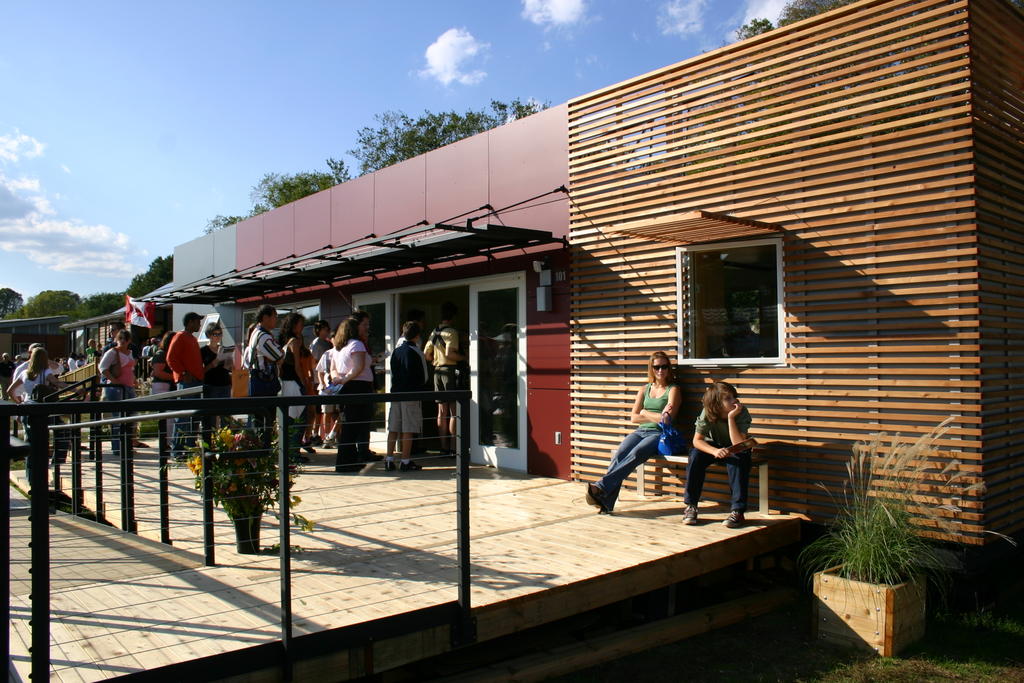
The Solar Decathlon brought together 18 teams of college students from around the globe to participate in a solar competition (sponsored mainly by the US Department of Energy). Their aim... To design, build, and operate the most energy-efficient and attractive solar-powered home. For a week or so, the lawns of National Mall Washington DC was transformed into a solar village. I was there to see it all. Two words .... Very cool !

I have always equated solar homes to regular homes with solar panels on the roof. Not any more!. Little did I know about phase change materials and its use to store energy. Solar thermal collectors that directly heat water and the space inside the house.

Little did I know of passive solar energy and the importance of daylighting to save energy. Low emissivity windows. Energy Recovery Ventilators (ERVs) that use heat exchangers to transfer heat from outgoing air to the incoming air.

Simply stated...Architecture, design, simplicity, efficiency and technology all play an important role.

The 18 teams were judged on all those categories. University of Colorado's solar home was declared the overall winner. Cornell University and California Polytechnic State University stood second and third respectively

BIO SIPUniversity of Colorado's key focus was modularity to promote mass production and use of natural materials to promote true sustainable construction. The materials used range from soy, corn, sunflower, canola and coconut. They are awaiting a patent on their remarkable biobased (soy) Structural Insulated Panel (SIP). They call it the BIOSIP.

The Cornell University's called its home the smart home with all its systems controlled automatically.

I found its grey water recycling system quite interesting. All of the water from the shower and bathroom drains are sent to a greywater filtration wall consisting of plants, gravel, and rocks. Filtration and landscaping cleverly put together.

Cornell students were most excited about their silicon gel based Energy Recovery Ventilator (ERV). It considerably reduces the energy required to cool and heat the house. Finally a noble use for silicon gel :)


In sharp contrast to Cornell, California Polytechnic relied less on automation. Their mantra was simplicity. Very few gadgets and controls. The design was more geared towards the warmer climate of California. It is designed to optimize solar gain in winter and minimize heat gains in summer. It gives the residents of the house almost complete control.
For the example the shade panels (as seen in the photograph) can be moved forward or backward depending on the season to let more or less sun in.


The common thread to all the 18 homes was a local climate centric design. The Canadians designed their home to withstand extreme cold winters. The Spanish design was in tune with the Mediterranean lifestyle. The team from Puerto Rico payed attention to their island life and locally available and renewable material.

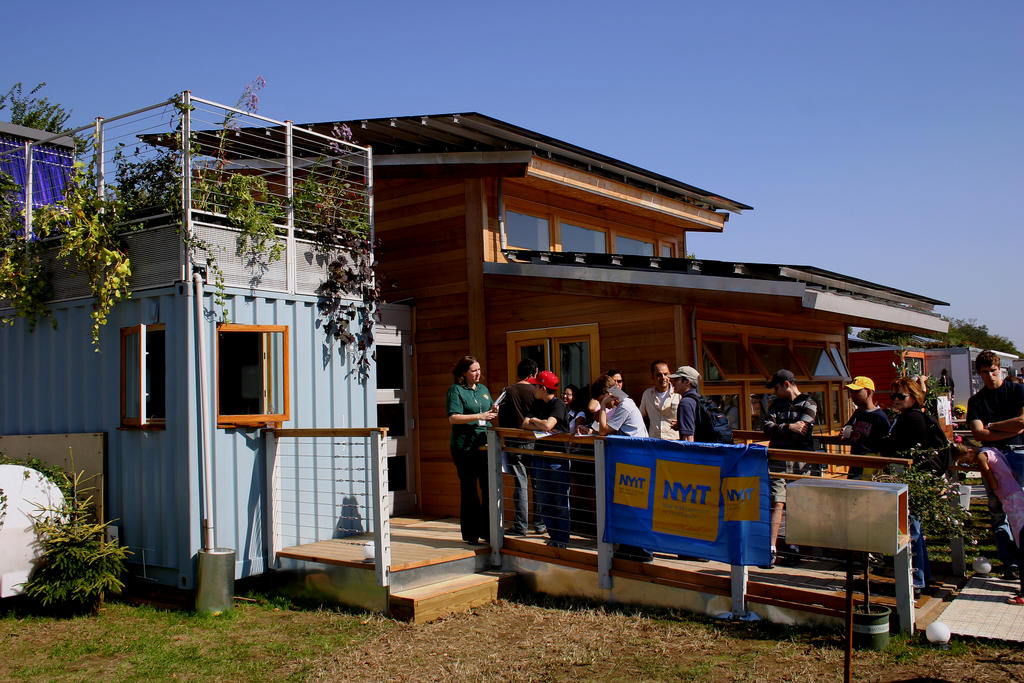
While all designs were good, I felt one in particular was exceptional and did not get its due credit. New York Institute of Technology (NYIT) was the only team to incorporate Hydrogen Fuel Cells into the mix. Electricity from a roof-mounted Photo Voltaic (PV) system is used to separate water into hydrogen and oxygen through electrolysis; the hydrogen is collected and stored and later used to power a fuel cell. The fuel cell recombines hydrogen with oxygen to supply electricity. This system replaces all those acid filled "not so environmental friendly" batteries.
The best part of the walk-through was when a volunteer from the NYIT team said this,

"Hydrogen is the most abundant thing on our planet. We wouldn't have to go to Iraq to get it".

There was immediate applause and cheer from the crowd.

Every team emphasized the fact the technology and the concepts used in their projects are not futuristic. GE makes them, BP Solar makes them and Home Depot supplies them. The technology is available today.

One has to applaud these students for their effort. They plan to take these projects back to their college and their communities to spread awareness, increase adoption and in some cases help draft new legislation. Hats off !. It is such a shame that the media coverage of this event was almost absent. These students deserve better.

The US department of Energy website has a wealth of information at http://www.eere.energy.gov/solar_decathlon
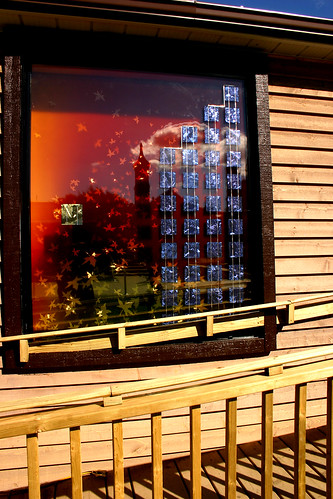
Solar WindowQuote of the day
"What is the use of a house if you haven't got a tolerable planet to put it on?"
~ Henry David Thoreau

PS:
All the houses had arrays of roof mounted PV panels. Everyone except NYIT had arrays of batteries also to store electricity