Saturday, December 30, 2006

Why Not Nukes?

A few fellow bloggers have asked me in the past what my thoughts were on nuclear energy. In a nutshell, I am just not comfortable with it.

The latest edition of Sierra has a great take on it. The article is by Paul Rauber

To affect global warming, says an influential study by the Massachusetts Institute of Technology, at least 1,000 new reactors would have to be constructed worldwide. Building those reactors would require a stupendous amount of money. Since capital is a limited resource, there would be less to spend on the many far-cheaper ways to cut down on carbon dioxide emissions: conservation, cogeneration (utilizing the heat produced by industrial processes to make electricity), and wind, to name a few. A dollar spent on energy efficiency would save seven times more carbon dioxide than a dollar spent on nuclear power.

In the end, it's not environmentalists wearing "No Nukes" buttons who have prevented any new reactor from being ordered in this country since 1978; it's Wall Street. Even with enormous subsidies from the Department of Energy and a taxpayer-funded shield from liability for major accidents through the Price-Anderson Act, no private utility has committed to building a new plant. Why? Because virtually every other form of power is cheaper and less risky. As Peter Bradford, a former member of the Nuclear Regulatory Commission, told the New York Times: "The abiding lesson that Three Mile Island taught Wall Street was that a group of NRC-licensed reactor operators, as good as any others, could turn a $2 billion asset into a $1 billion cleanup job in about 90 minutes." So the government can continue to subsidize the industry, says Amory Lovins of the Rocky Mountain Institute, but the effect "will be the same as defibrillating a corpse: It will jump, but it will not revive."


Makes me wonder...... Has India really done a thorough risk analysis with its ambitious civil nuclear program? A swarm of American companies are waiting to cash in on the deal. From technology transfer to Uranium mining. If I understand correctly, none of these companies have to worry about day to day nuclear plant operations. It indeed is a risk free way of making money. Will the fair weather crowd stick around if something horrible (God forbid) were to happen?

Monday, December 25, 2006

Merry Christmas


Merry Christmas every one!

Didn't venture out on the baking path this year. The photograph is from last year. It was fun. Thinking about it....... I wish I had done something this year

Sunday, December 24, 2006

Green smokestacks ?

Here is another solution that aims to take CO2 out of coal plants.

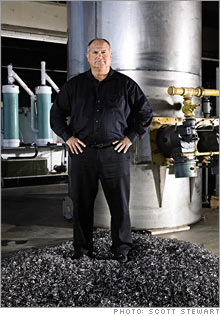
The exhaust from a coal plant passes through stainless steel rings where it mixes with specially treated water. CO2 gets absorbed and converted into Calcium Carbonate. Heat generated from this reaction is routed back into the plant. Calcium Carbonate has several useful applications.

Tom Kiser, the brains behind it has big plans for his latest invention. He calls it the liquid chimney.

via: CNN Money || via: SeventhGeneration.com
|| via: TreeHugger.com

This technology along with algae based technology I mentioned before could be used to cut down CO2 emissions immediately and arrest climate change. In the long run, we need to retire coal in favor of renewable energy. The environmental footprint of coal mining and burning is just too much and too ugly.

Sunday, December 17, 2006

Chattering Masses

"Traditional media are fragmenting. Focus groups are expensive, constrained and slow. New research shows that consumers are eager to evade advertising on television, block pop-up ads on the Internet and sign up for “do not call” lists to bar telephone solicitations.

At the same time, new surveys show that 90 percent of consumers trust word-of-mouth suggestions, and that some make purchases based on such guidance."

That is the premise of an interesting NY Times article titled, Brands for the Chattering Masses. Sophisticated search engines crawling the blogosphere, forums, message boards and other online spaces trawling for user generated opinion.

"BuzzMetrics’ computer scientists and programmers, led by Sundar Kadayam, a 43-year-old software engineer, say they have developed sophisticated search engines to sweep the Internet and drill down into rich veins of extemporaneous word-of-mouth commentary and conversation found online

Mr. Kadayam recently projected on a large white screen the company’s most promising new tool, which he calls Floodgate. It is a program that displays in real time what people around the world are saying on thousands of blogs and message boards. The program shows each new message as a blinking green dot that fades to light blue and then vanishes after a few minutes. The program can cluster messages according to general themes, and track keywords and phrases and the full content of what the writer is saying.

Marketing executives, awakened to both the threat and the potential, are scrambling to harness data culled online"

With more companies like BuzzMetrics getting their feet wet, there is a better chance that honest opinions and thoughts might show up on some fancy market research monitor. Greater chances that companies will listen. Wouldn't it be great if my thoughts (or yours) encouraged a company to turn a greener socially responsible shade ?

So chatter away!

Saturday, December 16, 2006

Climate Code

Me (probably like a lot of people) catch a glimpse of The Weather Channel during routine channel surfing. Until recently, I used to just surf through. Not anymore.

Climate Code with Dr Heidi Cullen does make for an informative half hour on alternate energy, climate change and general do good ideas.

Saturday, December 09, 2006

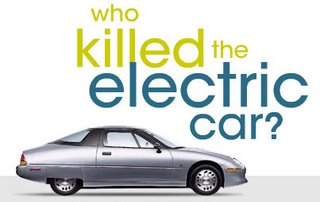
Who killed the electric car ?

This documentary/film created a lot of buzz when it was released back in June. Badly wanted to see it then but couldn't find a theatre that screened it. Now that the DVD is out, I didn't waste any time. I would summarize the movie in two words....."Must See"

The documentary goes about the question, "Who killed the electric car?" in the same manner a mystery novel would go about a murder. Starts off with a funeral scene. Ends with the guilty being revealed. It came as no surprise to find Oil industry, Bush and the American Auto makers(GM in particular) guilty. What came as a surprise were California Air Resources Board and Japanese Auto makers. The documentary details the part Toyota & Honda played in demise of the electric car. I had a good opinion of Toyota. Not sure I have it any more.

The documentary asserts the fact that electric car is a viable technology of today, unlike the pie in the sky Hydrogen counterpart. I am convinced that the Hydrogen hype is created in large part by the Oil industry to create a status quo that gives them the excuse to milk oil till its very last drop. I have written about Joseph Romm's book on Hydrogen before. He is in his best element in this documentary when he deflates Hydrogen hype.

I felt the documentary was a little weak on explaining the core concept of reduction in green house gases by switching to an electric car. I am sure everyone(like me) has the same exact question.
Don't electric cars create as much pollution as gas cars because electricity comes from coal plant ?
A partly convincing answer (from WhoKilledTheElectricCar.com )
The "“long tailpipe"” theory argues that electric vehicles do not really
create zero emissions, because the electricity needed to charge the batteries is produced in power plants. In June 2001, the Argonne National Laboratory released a US Department of Energy-sponsored study that found that battery-powered electric vehicles result in a 35% reduction in greenhouse gases. [25] This reduction was based upon electricity generation from the national grid, roughly half of which is derived from coal and roughly 30% of which is derived from clean, renewable sources like nuclear, solar, wind, biomass and hydroelectric power. [26] In 2004, an analysis of data from a California Air Resources Board staff report on greenhouse gas emissions from motor vehicles found that electric vehicles resulted in a 67% reduction in overall greenhouse gases in California, compared to a car powered exclusively by gasoline, and were nearly twice as effective in reducing greenhouse gas emissions than a hydrogen fuel-cell vehicle. [27] California'’s energy grid is considerably cleaner than the national grid, with roughly 20% of the states electricity being generated via coal-fired plants. [28]

Finally, some energy experts and utility analysts contend that millions of plug-in hybrid electric vehicles could be added to CaliforniaÂ’s fleet without substantially impacting the stateÂ’s current energy grid, since most of the charging for the plug-in hybrid electric vehicles could be done during off-peak hours, at night. [29] . It's estimated that 5,000 plug-in hybrids charging at night would represent less than 0.1 % of peak electrical demand in the state. [30] Moreover, they would also have strong beneficial environmental impact, since a plug-in hybrid vehicle that gets its energy from the grid during off-peak hours is thought to produce one-third the carbon dioxide emissions of an exclusively gas-powered car with a fuel efficiency of 24 mpg. [31] Tim Lippman of UC BerkeleyÂ’s Institute of Transportation Studies also points out that not only is our state and national grid becoming cleaner with increased use of renewable energy sources, but also that it is much easier to control emissions from a relatively small number of power plants than millions of tailpipes, each being a point of emissions and harmful, respiratory pollutants. Lippman also notes that emissions modeling research shows that when it comes to the concentration of harmful pollutants emitted from burning fossil fuels, height matters; the closer to the ground the emissions are, the more they tend to concentrate, making emissions from tailpipes at ground-level potentially more damaging than those from a coal-fired plant'’s smokestack, which may be 200 ft. or more of the ground.
The documentary ends however on a very positive and optimistic note. The successes of recently launched Tesla and promise of Plug-in Hybrids are very good reasons to be hopeful. This film along with An Inconvenient Truth, are essential elements in the debate and struggle for a sustainable tomorrow.

Wednesday, December 06, 2006

The Green Truth: Al Gore on the Oprah show

I have talked about the documentary An Inconvenient Truth before. The documentary has done really well. Yesterday, Al Gore was on the Oprah show talking about the topic.

I haven't seen the show yet, but Oprah's website does have a good summary.

In Europe and elsewhere, the discussion is about stopping Global Warming and developing solutions to reduce the adverse impact. Sadly in the United States, the discussion still tends to get stuck. The so called "Think Tanks" funded by vested interests litter the media waves with sound bites aimed at confusing people. Here is a classic example (from Oprah.com)

Marlo Lewis, senior fellow at the Competitive Enterprise Institute—a Washington, D.C., think tank—specializes in environmental policy and questions Gore's global warming claims. Recently, he wrote A Skeptic's Guide to an Inconvenient Truth to rebut Gore's research.

Marlo says An Inconvenient Truth makes it seem like we can reasonably expect the sea level to rise 20 feet in our lifetime or the lifetime of our children. "This is science fiction," he says.

Americans also shouldn't worry about environmental changes in Greenland or Antarctica, he says. "If you look at the actual loss of ice in Greenland and what it translates into, in sea level rise, it's about one inch over a century," he says. "Several studies show that the entire continent of Antarctica is actually gaining ice mass. That's an inconvenient fact that is nowhere mentioned in the film."

Marlo believes that Gore's film is an attempt to "scare us green." "He wants us to be very frightened of global warming," Marlo says. "The warming that we've seen over the last 30 years is constant and modest, and in all likelihood, will give us a modest amount of warming in the next century. And, therefore, it's nothing to be afraid of
And here is Gore's rebuttal (from Oprah.com)

Many of the organizations that have come out with studies questioning the effects of global warming are funded by the worst polluters, including certain oil and coal companies.

"They crank out so-called studies that are designed to make people think, 'Hey, there's no problem. Just let us keep on putting as much pollution up there as we want. Don't make us be responsible,'" he says.

For the true "expert opinion," Gore says people should take a look at a study conducted by the University of California. In this study, researchers conducted a peer review of experts' journal articles on global warming from the past 10 years.

The result? "None of them disagreed with the main consensus," Gore says. "There are some aspects of this issue where there is a continuing debate around the edges, but the central consensus is as strong as it ever gets in science."

In a special issue of Scientific American magazine, Gore says editors concluded that the debate on global warming is over. "It is real," he says. "It is happening now."


One can only hope that the new Congress will stay true to its word and do something real about the issue.

PS:
Former president Carter when asked(on Charlie Rose show) about 2008 presidential hopefuls, thought Al Gore should run and had this to say about him...."If you want to do something about Global Warming you get elected not just make movies".

Run Gore Run