Monday, August 29, 2005

Intersectionitis. Disease of the suburban mind

A month or so ago, I was hopelessly hoping for undo buttons in life. Why ? Well...I was involved in a car accident. Nothing major but definitely nothing minor. No one was hurt. It happened at a busy intersection when the light was turning yellow. It was not my fault. It was my right of way. It was my first accident.

Needless to say, the whole thing shook me up. For almost a week, the accident played over and over in my head.

I have always been a very careful and defensive driver. For the next couple of days, I was the most careful driver on the streets. Careful enough to be annoying. People would give me dirty looks as they passed me by.

My worst fears surfaced at traffic signals. I started dreading the yellow light. Every time I approached a long running green light, I would start praying..."God, please don't let it be yellow when I am crossing". Not wanting to speed up and not wanting to slow down, afraid of the guy itching to take the yield in front of me, afraid of the lady on her cell phone tail gating me, caught in a painful state of indecision and twitch. Intersectionitis!

It is estimated that about 1 million crashes occur on urban and suburban roads every year. The vast majority of them occur at suburban intersections. To make matters worse, we have the ugliness called suburban sprawl. It took me 10 minutes to reach my office a year ago. Today it takes about 30 minutes. Why ? More traffic and definitely more traffic lights. Woods and fields just vanish over a weekend. Only to be replaced by signs like "Future home of Costco" or "Future home of McDonalds" or a tennis court or a gas station.

A couple of weeks have passed since my accident. I thought my silly disease would pass me as well. I thought wrong. It haunts me still (not as bad). I looked around to see if there were others like me out there. I didn't find any. I did find an interesting solution though. Roundabout !

The new mantra is, "Yield at entry. No more lights and intersections"

Roundabouts are quite common in Europe. In America, it still is a rare sight. My first run-in with a roundabout was in Massachusetts. I have to admit, I was a little dizzy the first time! I became a pro by the second time.

According to studies, roundabouts have been found to be very efficient and safe. Most importantly, it reduces fuel consumption and smog.

As I see it, roundabouts are the only cure for intersectionitis. Please do let me know if there is a different cure out there.

Quote of the day
"Suburbia is where the developer bulldozes out the trees, then names the streets after them"...Bill Vaughn

Wednesday, August 24, 2005

Biodiesel. The dark side

It is safe to say that a concept has enough momentum when somebody you know says, "My dad is already doing something along those lines!" This was the reply I got when I was casually mentioning the Jatropha fever to a friend of mine.

D1 Oils a UK based biofuel company and its aggressive goal is one of the reasons why many people in India are familiar with Jatropha. The company plans to have Jatropha cultivated in 5 million hectares of land in India in the next five years. Mechanized and intensive, the vast majority of the bio diesel produced will be exported to the developed countries.

What ? Wait a second...

The original green dream was to have small and medium farmers in drought prone and degraded areas do organic bio diesel farming. The idea was to help the farmers, help the environment and lessen India's oil dependence. So when something like D1 Oils shows up , one can't help but wonder... Is that a good thing ?

GoodnewsIndia.com asks the question, "Will global carpet-baggers transform themselves into environmentalists, fan out into the developing world and make a tidy profit?"

Here is another sobering thought from Monbiot

"The market responds to money, not need.

People who own cars have more money than people at risk of starvation. In a contest between their demand for fuel and poor people'’s demand for food, the car-owners win every time. Something very much like this is happening already.

Though 800 million people are permanently malnourished, the global increase in crop production is being used to feed animals: the number of livestock on earth has quintupled since 1950.The reason is that those who buy meat and dairy products have more purchasing power than those who buy only subsistence crops."

Soy is another classic example of a good idea going over to the dark side. Soy cultivation today is responsible for large scale destruction of tropical forests and displacement of native tribes in South America.

I feel, we urgently need a sound and scientific national policy on biodiesel. It is a little reassuring to know that the Indian planning commission has put together a draft national bio-fuel policy. I haven't been able to find the entire policy document yet. I can only hope it is based on sound principles.

We need to make sure biodiesel stays biodiesel and not become a biohazard.


PS:
Prof Shrinivasa of Sustainable Transformations has used the seeds from the native tree Pongamia to make biodiesel and electricity in remote and poor villages. Pongamia unlike Jatropha, is a native species and is a tree with a greater life span (80 years).

Also, myths and facts about biodiesel can be found here

Friday, August 19, 2005

President Kalam and the Physic nut

India's current and future energy consumption is a matter of worldwide concern. So when the President Dr Abdul Kalam spoke of energy independence on the eve of India's independence day, it created quite a buzz.

The speech can be found in its entirety on his website presidentofIndia.nic.in

It is often refreshing to listen to the President. Being a scientist himself, he understands the issues and the technologies involved. His style has always been to use science, statistics, economics and vision to create positive public debates and industry participation. I found his emphasis on renewable energy in the speech very reassuring. But... He goes on to promote Coal and Thorium based nuclear energy also. Add to that, he only vaguely refers to global warming. So, I found the speech inspiring and yet disappointing!

India consumes about 114 million tons of oil annually. Almost the whole of that (112 million tons) is used in the transportation sector. Simply put, to solve the problem of oil dependence one needs to focus on transportation. So when the President says that there is a potential to replace 60 million tons (50%) of oil imports with eco friendly bio diesel from energy plantations like "Jatropha" on degraded waste land...... My green radar system screams "WHAT ? HOW ? WHERE ? SERIOUS ?". My Google happy fingers furiously search for more information.

So what is Jatropha ? Jatropha Curcas aka Physic nut is a low growing tree native to South America. It is now grown in many parts of Africa and Asia. It is a vigorous drought and pest resistant plant. It can grow in soil degraded land and even better, is known to restore soil nutrients. The plant has several medicinal value. Most importantly its seeds have high oil content. A hectare of relatively dry degraded land is known to produce about 1 ton of oil. The oil has excellent bio diesel properties and India has about 60 million hectares of degraded land. Hence, the President's statement (and the title of my post)

The plant has been known to the natives of South America for centuries. It was brought into the spotlight by two professors at University of Hohenheim, Prof Dr K Becker and Prof Dr G Francis. Their case study on India and Jatropha can be found here

The study finds production of bio diesel to be almost carbon neutral. If India were to successfully deploy Jatropha, not only can India reduce its oil dependence but also gain significant carbon credits. The Center for Jatropha promotion in India is already engaged in this activity.

Now, before we make Jatropha the next super hero, we need to understand certain things. For one it is a non native plant. The perils of introducing non native vegetation is a common painful knowledge. Also, the idea is to cultivate the plant in wastelands and not on viable farmlands. If Jatropha is to go the way Ethanol is going in North America, it might not be entirely carbon neutral and eco friendly.

A burgeoning Indian population is exerting immense pressure on existing forest cover. Unregulated human activity is creating more and more wastelands. Small and medium farmers are suffering from drought and land degradation. From what I have read so far, I think, Jatropha has the potential of creating a positive impact in India. I hope it doesn't create a negative one

Quote of the day
"When one tugs at a single thing in nature, he finds it attached to the rest of the world"...John Muir

Wednesday, August 17, 2005

A little down time

This post is largely due to the folks at Microsoft. Thanks to the ever present vulnerabilities in Windows, you are always one hack away from some quality down time.

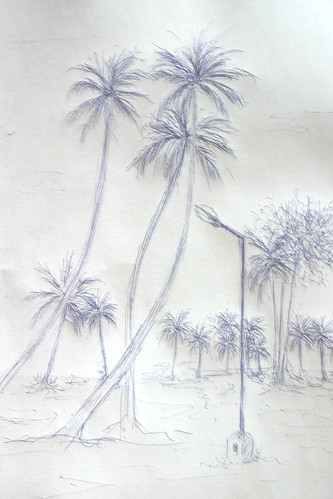
My PC was among the many that became a zombie yesterday. All I could do was shut down and wait patiently for the vaccine. It was then that I realized by sheer dependence on my PC. I felt helpless and very restless. For a while I tried doing this and that. Finally, I settled into something I have always loved doing. I grabbed a piece of paper and started sketching.

This sketch is inspired by a photograph. A photograph of tall coconut trees found in Kerala. The theme of the photograph is height. I am not sure if I did justice to the theme.

As I was sketching, I started thinking back to the funny days of college. As a fresher (freshman) it was an art, to evade and survive the first few months. We always had to maintain a low profile and never get into any trouble with the seniors. They could make life very miserable.

The key to survival was simple. Never be boring and never be interesting. In other words, don't attract attention for the right or the wrong reasons.

I could never do that. Everytime a senior asked me about my hobbies , I would say hiking and landscape sketching/water coloring. The response was almost always predictable ..."WHAT ?. What the hell is landscape water coloring ?". The questions would just keep coming after that. I somehow managed to survive all the questioning.

Looking back, the first (freshman) year was the most fun.

Anyway, getting back to the topic of sketching, here is a great quote by Fran Lebowitz, "Very few people possess true artistic ability. It is therefore both unseemly and unproductive to irritate the situation by making an effort. If you have a burning, restless urge to write or paint, simply eat something sweet and the feeling will pass"

I think I need to stay off the sweets.

Saturday, August 13, 2005

Down with The Economist

In one of my earlier posts, I had talked about Future Forests. Surya of Silent Eloquence was kind enough to point me to an article titled, Down with the trees in The Economist. The article basically cited two studies to draw a dramatic conclusion, "Planting trees can exacerbate drought and fail to tackle climate change"

The first study was from university of New Castle, UK. This study was about forests and water. The second was from an article published in Nature by a team of American and Brazilian scientists. This was about forests and carbon absorption

At first read, I knew there was something seriously wrong about the Economist article. I was right, the article was just cheap sensationalism.

The Economist apologized for its misleading conclusion on carbon absorption. It printed a correction. So trees do help tackle climate change. Now what about the trees "exacerbating drought" jingle. I did a little searching...

The study by University of New Castle can be found here

The aim of the study is clearly outlined in its introduction, "The ecological importance of forested lands is not being questioned and underestimated, but the need to be better informed while designing land and water management programs such as watershed development, is being emphasized"

In other words, governmental agencies should make informed policies and decisions when it comes to designing and implementing land and water management projects. Not just drumbeat that planting trees will solve every water problem and bring more rainfall. As the study points out, one needs to be aware of complex issues like local climate, average annual rainfall, native vegetation, soil properties, downstream ecology and more. Planting eucalyptus trees in an arid region or planting date palms in a tropical region is nothing but foolishness.

The study makes it very clear...Destroying an ecosystem is very easy. Recreating it takes research and a lot of effort. One thing is for sure, amateur journalism doesn't help the situation at all. Here is my letter to the editor of The Economist
******
Sir/Madam,

This is in regards to your article titled Down with trees, dated July 28th 2005.

I have to say your article is nothing but knee jerk journalism. You have conveniently and incorrectly used two studies to draw a dramatic conclusion. I am aware of the fact that you have printed a correction. The correction still doesn't address your inaccurate conclusions about forests and droughts. You have quoted the study out of context. The study by the University of New Castle UK is clearly trying to emphasize the importance of informed and scientific decisions when it comes to water management projects. We all understand the harm of introducing non native vegetation. Such activities can only the exacerbate an already stressed ecology. So can articles like yours.

Sincerely
One More Reason

Tuesday, August 09, 2005

For the Indigenous people

August 9th is being celebrated as the International Day of the World's Indigenous People.

There are about 300 million indigenous men, women and children worldwide. They define the term diversity. More than 5,000 different groups of indigenous people live in more than 70 countries. For a millennia they have lived a rich life, in peace, and in harmony with nature. Exemplifying true sustainable living. Ironically, today they find themselves catalogued as extremely poor.

Couple of months ago, I visited the beautiful island of Kauai. I remember the boat ride along the Wailua river. The tour guide was native Hawaiian. He asked us if we had a chance to taste traditional Hawaiian soul food. It is usually made of taro and requires slow and patient cooking. I wanted to taste it, but couldn't find a place that served it. Every one was silent. The tour guide smiled and said, "We ourselves haven't eaten it in a long time. McDonalds is much easier"

That pretty much summarizes the plight of indigenous people today. All the diversity and rich culture is getting systemically lost under Walmartization, McDonaldization and other homogenizing trends of globalization.

One of the great things about free market economy is the use of law to do unlawful things. The atrocities against Native America is a classic example. Jennifer of whatbox has been writing an emotional series on Native America. Atrocities committed against them in the name of gold, oil,coal, gas and religion, their lives, their hardships, their struggle. It has been eye opening.

Andaman and Nicobar Islands in India is yet another tragic story. Indian government's atrociously stupid policy of assimilation has reduced a 10,000 strong aborginal population (a century ago) to a mere 900.

It will take more than a day of celebration to stop and undo the injustice. It is a start nevertheless. UN's theme for today is "The Cause of Indigenous People is Ours".

There is a growing realization that the cause of Indigenous People is linked to our common global future and health. They offer the best example of sustainable development. Let us respect that, let us understand that, let us imbibe that.

Link: UN Permanent Forum on Indigenous Issues

Quote of the day
"The Cause of Indigenous People is Ours"

Monday, August 08, 2005

Peter Jennings 1938 - 2005

Peter Jennings reporting from India for Mother Teresa's 1997 funeral.

In a time, when the American media is increasingly scarred of the right wing, Peter Jennings was one of the few with a spine.


Quotes of the day
"As for his own political opinions, I could never work them out. He would not tell me what he really thought about Clinton or George W Bush, and I eventually stopped asking him"... John Simpson BBC world affairs editor

"He loathed the arrival of the Fox network, with its open, noisy adherence to a political agenda, and believed it would destroy the old-fashioned notion of honest and unbiased reporting forever" ...John Simpson

"With Peter on the story, you always knew you weren't going to sleep very much because you had to have your eye on him all the time. But you also knew how ethical he was and what a passion he had for news"... Dan Rather

"Peter did what he could to halt the downward spiral of television news in America - that terrible turning inward, which means the less you know about the world, the less you want to know about it, and therefore the less a ratings-obsessed industry decides to tell you" ...John Simpson

Carl Pope on the Mumbai rains

[..]

Two weeks ago, in a foreshadowing of what we can expect to see happen more and more often as we destabilize the global climate, this city received 37 inches of water in one day. I cannot begin to fathom what that must have been like to experience -- more than three feet of water falling in a single day. One friend said it was like a river falling straight down from the sky.

[..]

Reactionary economists tell us it wouldn't be cost-effective to take preventive action on global warming. Well, this city generates 40 percent of the tax revenues for the whole government of India. For three days, no buses ran and the stock market was closed. Multiply this tragedy by a thousand, by ten thousand. Would having cars and trucks that accelerated a little less quickly, installing more modern equipment in factories, sealing leaks in houses, or building windmills in the Dakotas instead of importing oil from Saudi Arabia really be too high a price to pay to avoid such disasters?

For the people of Bombay, the unwillingness of my own government to act responsibly is, literally, a matter of life and death. I sometimes wonder why they are so nice to us.


Link: A River from the Sky

Thursday, August 04, 2005

View from up there !

"The atmosphere almost looks like an eggshell on an egg, it's so very thin"...Discovery Commander Eileen Collins

She describes how widespread environmental destruction on Earth could be seen from the shuttle.

"Sometimes you can see how there is erosion, and you can see how there is deforestation. It's very widespread in some parts of the world. We would like to see, from the astronauts' point of view, people take good care of the Earth and replace the resources that have been used."

The view from up there...Not good. My tree hugging heart sinks. In moments like these, I reach out for support. Nothing dramatic, just my ipod and ColdPlay. I am a big fan of ColdPlay. If you like them, here is a reason to love them.

They are one of the few who really care about the environment. They are one of the biggest supporters of future forests.

The name future forests says it all. The aim is to simply "replace resources" and restore carbon balance. Future Forests gets involved in a wide range of forests around the world. They work with planting partners in UK, Mexico, India, Germany, North America and Canada.


One project in particular caught my attention. In Gudibanda, Karnataka, India future forests have joined hands with Women For Sustainable Development, to create a forest of mango trees. The project is unique in the sense that it provides both carbon absorption and viable income for the locals. Truly a great story.

I say unto thee. Adopt a tree. Let the tree hugger in you be free.

Update: The project to plant mango trees did not go well. Read about it here


Quote of the day
"He who plants a tree, plants a hope"... Lucy Larcom, "Plant a Tree"

Monday, August 01, 2005

Sudan, uncanny resemblance to Rwanda

Sudanese police have quelled riots and imposed a curfew in Khartoum after anger at the death of ex-rebel leader John Garang spilled on to the streets. More...

A decade ago, a similar situation in Rwanda sparked a gruesome chapter. Hope Sudan doesn't fall prey.